Definition
A perpetual future is a futures contract with no expiry date. You hold a long or a short on a coin's price for as long as you keep enough margin in the position, and a periodic funding payment between longs and shorts is designed to pull the contract's price toward the spot price. You hold a contract on the price, not the coin.
Most leveraged crypto trading happens on perpetuals. The contract adds four things to a price chart: margin that backs the position, a mark price that, on most exchanges, decides liquidation, funding you pay or receive, and fees on the full position value. Use this page to decide whether you know a contract's mechanics well enough to put an order on it, and which of its costs and risks apply to a position you have already sized from its stop.
How it works
Why there is no expiry
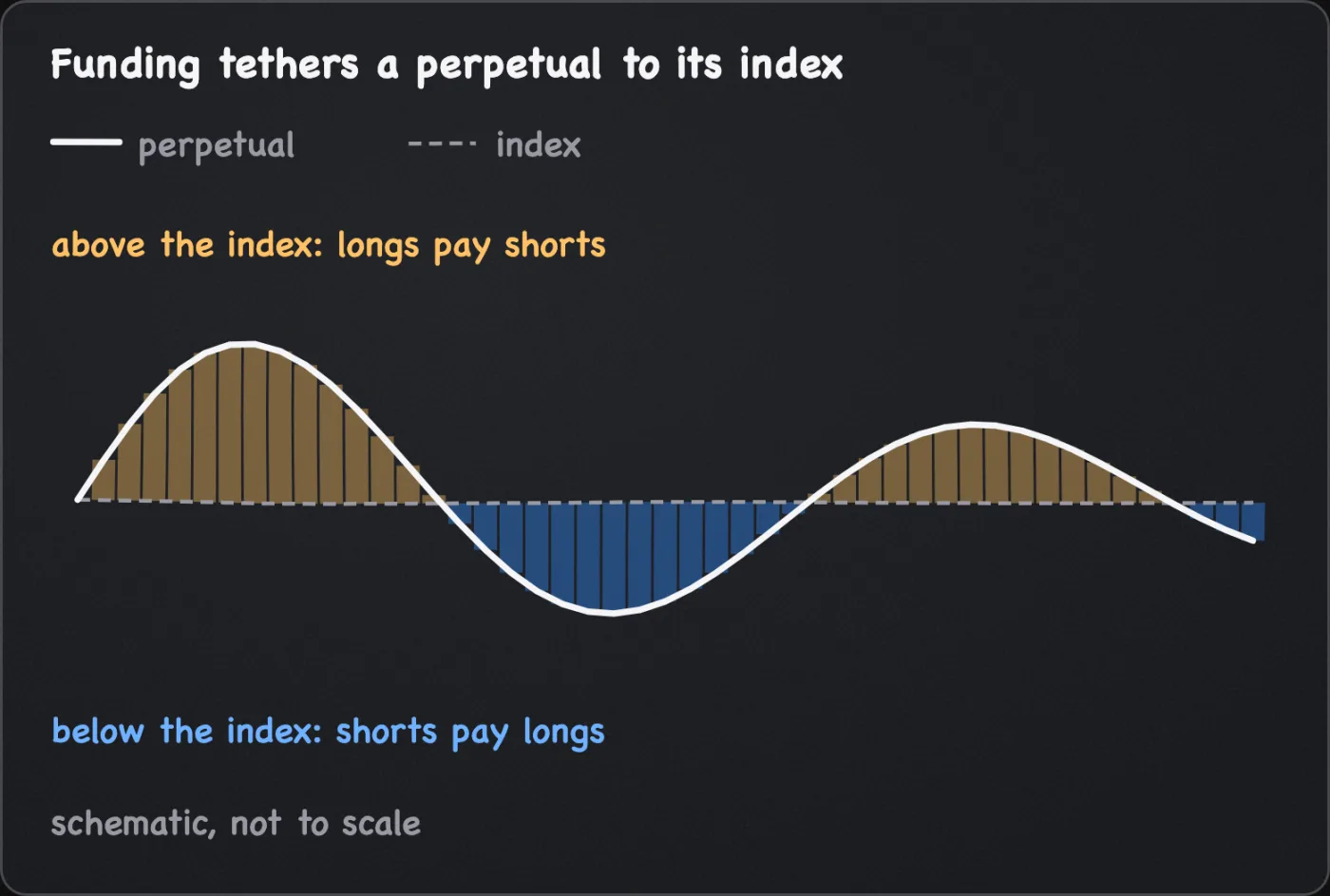
A dated futures contract settles on a fixed day, and its price is pulled toward spot as that day nears. A perpetual never settles, so it needs another tether: funding. When the contract trades above the spot-based index, the funding rate tends to turn positive and longs pay shorts, which makes holding a long dearer and a short more attractive. When it trades below, the payment runs the other way. That is a pull toward the index, neither immediate nor guaranteed. Funding rates covers the rate and what an extreme figure says.
Index price, mark price and last price
Three prices are in play, and they are not the same number.
- Last price. The latest trade on this contract's own order book. Your fills come from this book.
- Index price. An average of spot prices from several exchanges, each exchange picking its own sources.
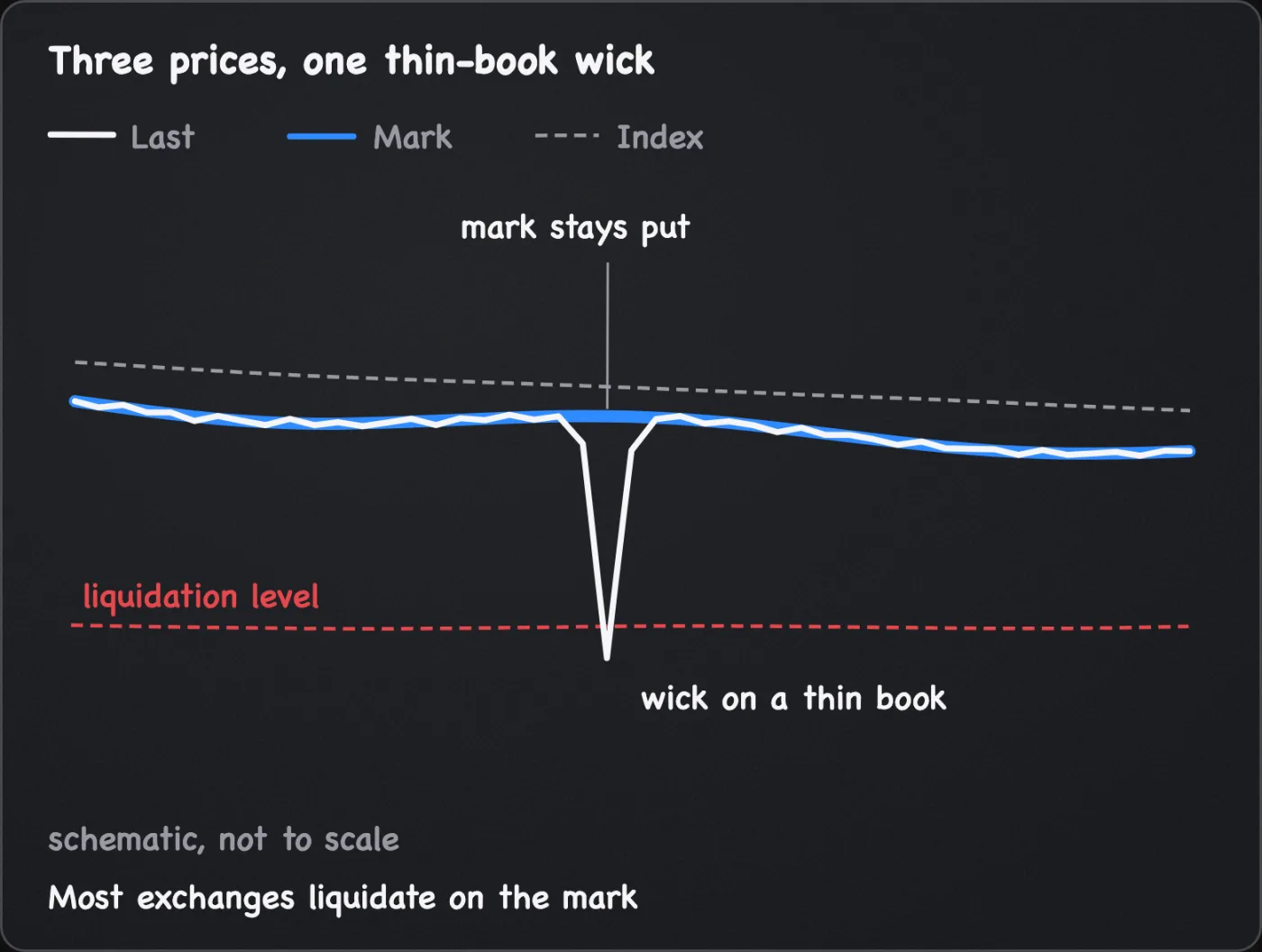
- Mark price. The exchange's estimate of a fair price for the contract, built from the index plus a smoothed gap between the two. The formula differs by exchange.
Most perpetual futures exchanges trigger liquidation from the mark price, and often use it for the unrealised profit and loss on screen. One wick on a thin book moves the last price and can leave the mark price almost where it was. A real move across the market moves both. Many order forms let you pick which price triggers a stop, so read the field. The liquidation price page has the formulas.
Margin and position value
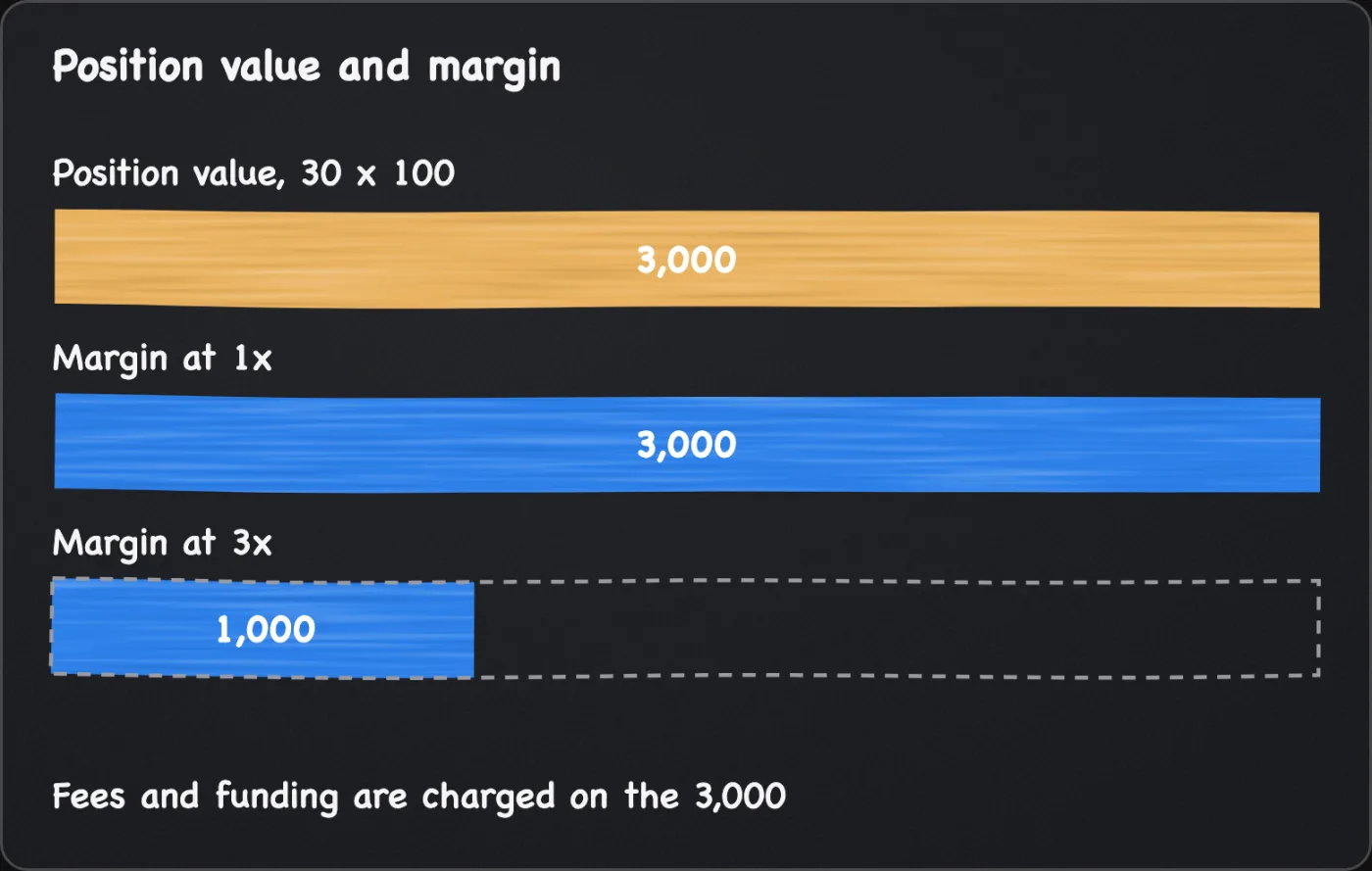
Margin is the collateral locked while the position is open. Position value is size times price, and the leverage setting is position value divided by margin when the position opens. The real ratio drifts as price moves, so this manual also checks position value over account equity. Fees and funding are charged on position value, not on margin.
For arithmetic only, assume a price of 100 and a long of 30 units. Position value is 3,000. At a 3x setting the margin is 1,000, at 1x it is 3,000. The planned loss at the stop comes from the 30 units and the stop distance, so it is the same at either setting. The leverage page covers the setting, and position sizing covers how the 30 units were chosen.
Linear and inverse contracts
A linear contract, such as a USDT-margined perpetual, is margined and settled in a stable quote currency. An inverse contract is margined in the coin itself, so profit and loss are in the coin and the account value moves with its price. The sums in this manual assume a linear contract and do not apply to an inverse one.
Isolated and cross margin
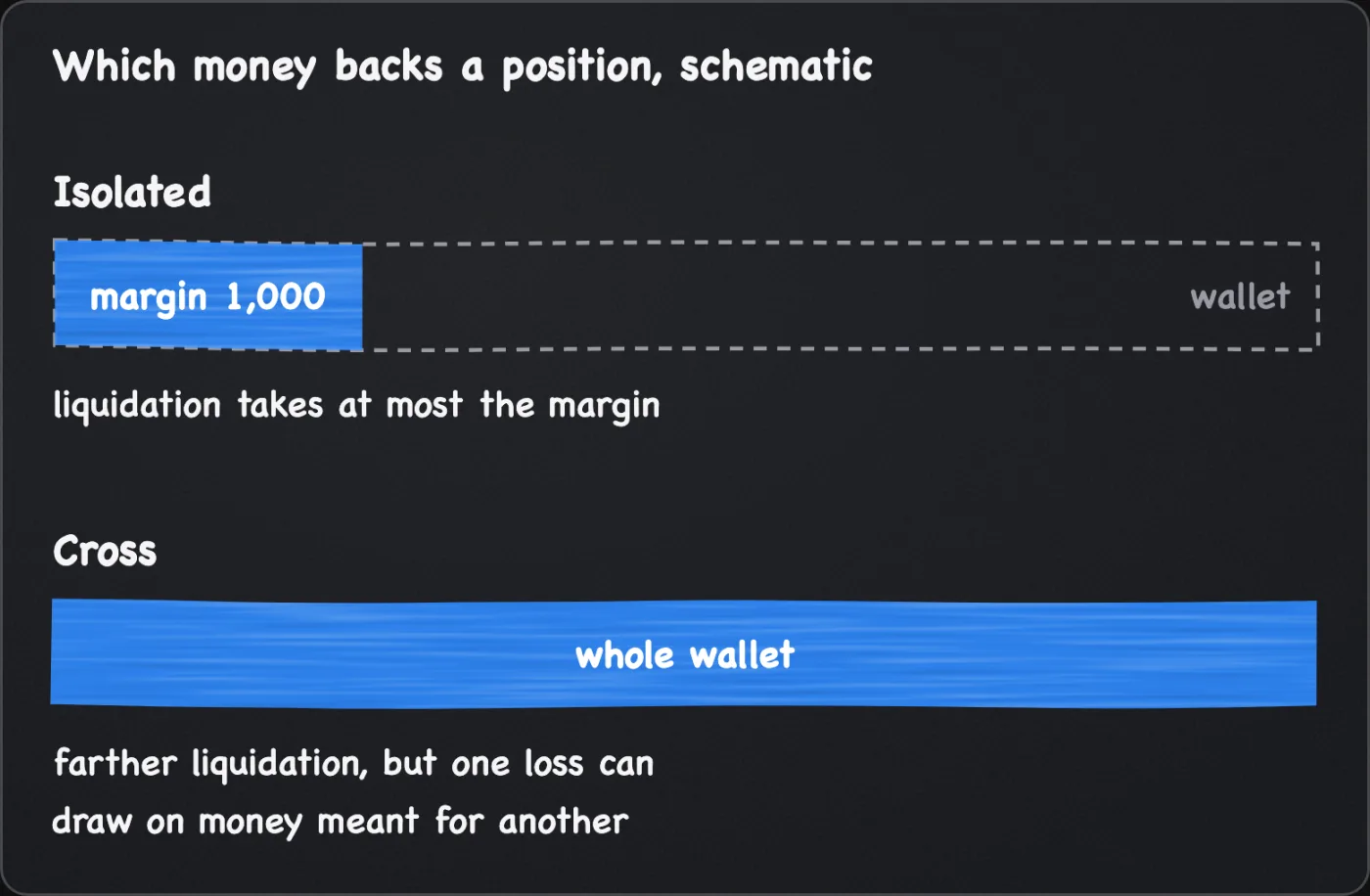
On isolated margin only the margin you assign backs the position, so liquidation takes at most that, unless margin is added. Some exchanges offer an auto-add option, which should be off if you want the limit to hold. On cross margin the wallet's available balance backs every open position, so liquidation sits farther away and one losing trade can draw on money meant for another.
Perpetual, spot and dated futures
| Spot | Dated future | Perpetual | |
|---|---|---|---|
| You own the coin | Yes | No | No |
| Expiry | None | Fixed date | None |
| Funding payments | No | No | Yes |
| Liquidation price | No, if bought without borrowing | Yes | Yes |
Default settings
This page cites no published default for these choices, so the table lists the reference values this manual uses.
| Item | Value | Status and limitation |
|---|---|---|
| Contract type | Linear, margined in a stable quote currency | This manual's choice. Its sums do not apply to inverse contracts. |
| Margin mode | Isolated | This manual's choice. It limits each position's loss to its assigned margin, not the planned losses of positions that stop out together. |
| Leverage ceiling | 3x, on the setting and on position value over account equity | House constraint, a choice and not a recommended allocation. Lower is allowed. |
| Funding interval | Commonly every 8 hours | Convention. It depends on the exchange and the contract, so read the contract page. |
| Price that triggers liquidation | Mark price on most exchanges | Convention. Check the exchange's own rules. |
How it is used in this manual's setups
The setups are written for a perpetual, because that is where a short or a leveraged long is placed. The stop, the size and the cost allowance come first, then the contract's mechanics are read off the order ticket. The ending diagonal breakdown is a short, so a positive funding rate pays the position, which matters only for a trade held across payment times. The decision cycle puts these checks at the risk budget and execute steps, and trading costs and liquidity shows how funding enters the allowance. The funding scanner lists current rates across contracts. The manual route is the contract page on your exchange.
Common mistakes
- Treating a perpetual as owning the coin. There are funding payments and a liquidation price. Read both before you open the position.
- Reading the chart's last price as the liquidation trigger. Check which price your exchange uses for liquidation and for your stop, and keep the stop well inside the liquidation distance.
- Ignoring funding on a multi-day hold. It is charged on position value at every payment time, so add it to the cost allowance for the planned hold.
- Using linear sums on an inverse contract. They do not apply. Find the exchange's inverse formulas first.
- Leaving the margin mode as the last position had it. Read it on the order screen before you confirm.
- Skipping the contract page. Funding interval, tick size, minimum order and maintenance tiers all sit there and vary by contract.
What this cannot tell you
- Your exchange's numbers. Funding interval, fee tiers, maintenance margin and trigger-price options differ by exchange and contract. The contract page and the order ticket decide, not this page.
- That the contract is tracking spot right now. In a fast market a perpetual can trade away from its index for a while, and funding pulls it back gradually, not on a schedule you can rely on.
- Whether an exchange is safe to hold funds on. The mechanics here say nothing about its solvency or rules.
Questions
What is the difference between perpetual futures and spot trading?
Spot buys the coin itself, with no expiry, no funding and no liquidation price. A perpetual is a contract on the price: it uses margin, charges or pays funding, and can be closed by force at the liquidation price.
Do perpetual futures expire?
No. A perpetual has no settlement date, which is why funding exists, so you can hold it as long as you keep the margin up and can pay the funding. An exchange can still delist a contract and close open positions at a price it sets, so check notices for coins you hold.